Everyone, especially parents, should be familiar with choking infant guidelines. Learn common causes of infant choking, tips on how to prevent it from happening, and what to do if it does happen.
Infant Choking
Choking is a common problem in infants. Their airways are small, their ability to properly chew and swallow food is not yet mastered, and their ability to cough forcefully may not be sufficient in removing the object. Food and small objects are the most common causes of choking.
You have only a few minutes to remove the object (as little as 4 minutes without oxygen can cause permanent brain damage) so, to act quickly, it is important that you are familiar with the choking infant guidelines. Knowing how to prevent choking is also important.
The signs of true infant choking include inability to make sound or cry, difficulty breathing, high pitched inspirations, ineffective cough, and bluish discoloration of the lips, nails, and/or skin.
Guidelines (infant under 1 year)
Do not perform the following if the infant has a strong cry or is coughing forcefully. Click on images to enlarge.
Back Blows
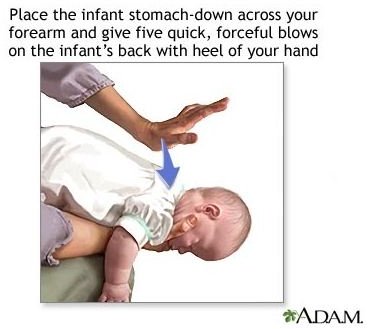
Place the infant (face down) over your arm with his head lower than his trunk and his head supported (hand under the chest and fingers around the jaw). Additional support can be achieved if you rest your arm on your thigh.
Give 5 quick, sharp back blows between the infant’s shoulder blades with the heel of your hand.
Chest Thrusts
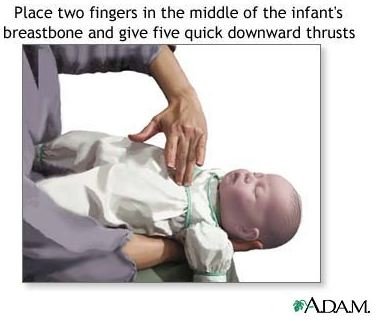
After 5 back blows, take your free hand and place it flat on the infant’s back so that the infant is “sandwiched” between your two hands, making certain the neck and chin are well supported. Turn him over so he is on his back (with the head lower than the trunk) on your thigh.
Place 2 fingers on the infant’s breastbone (just below the nipples).
Give 5 quick thrusts. Press down about 1/3 to 1/2 the depth of the chest.
Repeat
Continue giving 5 back blows and 5 chest thrusts until the object is removed or the infant becomes unconscious.
Unconscious Infant
Shout for help.
Start CPR .
Dos & Don’ts
Once the object is removed, even if the infant appears okay, DO have the infant seen by a health care provider.
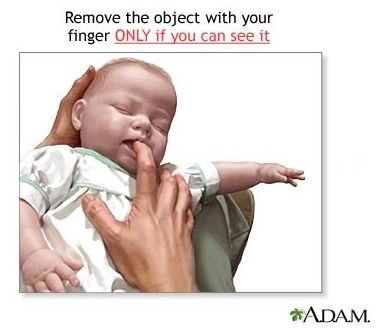
DON’T attempt to remove an object from an infant’s mouth if you can not see it.
Tips on How to Prevent Choking
Do not introduce solid foods too early. Wait until the infant is at least 4 months old before introducing pureed solid foods.
Supervise the infant while he is eating.
Avoid giving high-risk foods, including hot dogs, whole grapes, popcorn, nuts, raisins, large pieces of meat, and hard candy.
Avoid high-risk toys, including small balls, marbles, and toys with small parts. Check age guidelines when buying.
Keep objects out of reach that can cause choking, such as coins and buttons.
Conclusion
The above choking infant guidelines can be beneficial but I highly recommend you attend a certified first-aid training course. Visit the American Heart Association to find a class near you.
Share this information with family and friends and make sure anyone who cares for your infant knows what to do if choking occurs.
Learn How to do the Heimlich Maneuver on Children & Adults
Sources Used
Medline Plus: Choking - infant under 1 year - https://www.nlm.nih.gov/medlineplus/ency/article/000048.htm
Mayo Clinic: Infant choking: How to keep your baby safe - https://www.mayoclinic.com/health/infant-choking/MY01224
Photo Credit
All images courtesy of the National Library of Medicine (NLM).