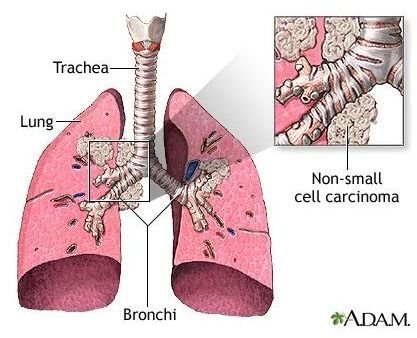
Bronchoalveolar adenocarcinoma (BAC) is a type of lung cancer. It has a characteristic, non-invasive growth pattern. Unlike many other forms of lung cancer, bronchoalveolar lung cancer is seen in patients of variable age and is not strongly associated with smoking.
Diagnosis of BAC
Methods commonly used to reach a diagnosis of lung cancer include visual examination of the lung with fibre optics (bronchoscopy), and microscopic examination of cells obtained from pleural fluid or sputum (cytology). However, because lack of invasion is the key feature of BAC, a definitive diagnosis usually requires a tissue specimen obtained during surgery. Recognition of bronchoalveolar lung cancer as a noninvasive tumor distinct from other types of lung adenocarcinomas is important because it has implications for treatment and prognosis.
BAC - Clinical Characteristics
BAC often differs in its clinical characteristics to other types of non-small cell lung cancers, including:
- frequent female occurrence, especially in East Asians
- commonly seen in patients with no history of smoking
- indolent course (causes little or no pain)
- presentation as asymptomatic, small tumors
Pathology of BAC
BAC develops in the terminal bronchioles, the small airways of the lungs and the alveloi (air sacs). Its growth pattern is described as ’lepidic’. It differs from many other lung cancers in that it grows along alveolar septa and lacks vascular or pleural involvement.
Bronchoalvelor lung cancer is often sub divided into mucinous and nonmucinous BAC. Some consider these types as distinct entities despite similar histologic growth patterns. A related tumor is the peripheral adenocarcinoma (ADC mixed subtype), many of which appear to arise from BAC and often contain BAC elements.
Small tumors of pure BAC type do not usually invade normal tissue or spread to other organs and can be surgically removed. Recurrence is unlikely, hence survival rates are good.
Adenocarcinomas with definitive invasion and no BAC-like component are more aggressive than those classified as mixed BAC characteristics (at least 10% lepidic growth pattern) and have a worse prognosis. Male smokers with small adenocarcinoma tend to have a more aggressive tumor pattern. Outcomes are the most bleak for patients who have been heavy smokers.
Treatment of BAC
Lobectomy (surgical removal of a lobe of the lung) is considered to give the best chance of cure, but less extreme procedures such as wedge resection or segmentectomy are also appropriate in some cases. Follow up consolidation therapy (chemotherapy or radiotherapy) is commonly given. Relapses can be difficult to treat and are often fatal. Because recurrence tends to be confined to the lung, lung transplantation may have potential here, however this procedure is rarely performed.
Mutations in the epidermal growth factor receptor (EGFR) gene are often present in BAC. In such cases, there is the option of treatment with tyrosine kinase inhibitors, which can interfere with tumor growth. Some dramatic and long lasting responses have been seen in patients with certain EGFR mutations after treatment with tyrosine kinase inhibitors.
References
The bronchioloalveolar carcinoma and peripheral adenocarcinoma spectrum of diseases. D.Garfield, J.Cadranel, M.Wislez, W.Franklin & F.Hirsch. Journal of Thoracic Oncology. 2006, Vol 1, P344-59.
Update in Neoplastic Lung Diseases and Mesothelioma. I.Gordon, S.Sitterding, A.Mackinnon & A.Husain. Archives of Pathology & Laboratory Medicine, 2009, Vol 133, P1106-1115.